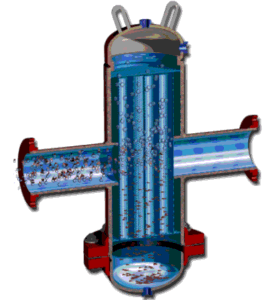
Asset ID: air-dirt-separator-working-principle-1.jpg – Cross-Sectional Flow Diagnostics and Coalescing Path
The standout structural feature is its flanged removable top cover. It allows full access to the internal coalescing core for offline cleaning, ensuring maximum maintenance convenience without tearing down or disconnecting the main plant room piping.
Engineering & Design Advantages
- High-Density Spiral Coalescing Core: Equipped with internal Stainless Steel 304 (SS304) spiral mesh configurations that break fluid down into laminar turbulence, promoting maximum micro-bubble collision and particle separation.
- Offline Core Serviceability: Built with a specialized flanged removable top cover. Maintenance crews can fully pull out the internal mesh core for direct washing without tearing down or disconnecting heavy main plant room piping.
- Glycol-Chilled Water Compatibility: Optimized to handle clean water as well as dense industrial Water / Ethylene Glycol mixtures up to a 1:1 volumetric ratio.
- Anti-Vandalism & Tough Shell: Engineered from high-grade industrial-coated carbon steel to resist high-velocity stress while maintaining an operating ceiling of 110°C (230°F) and 8 bar pressure ratings.
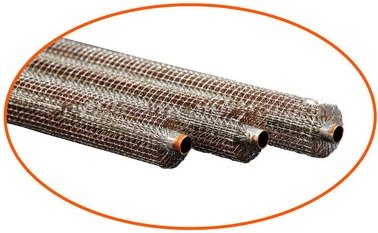
High-Density Stainless Steel 304 Spiral Mesh Internal Core Tubes
Product Description & Dual-Action Operation
Laminar’s custom-engineered Removable Spiral Micro-bubble Deaerator & Precision Dirt Separator (ADS) provides dynamic online protection for high-velocity closed-loop HVAC chilled water, heating networks, and demanding industrial process loops. Conventional strainers only intercept massive particles, leaving fine debris and dissolved air to compromise system efficiency. Our high-efficiency system utilizes Dual-Action Fluid Dynamics to treat both invisible internal threats simultaneously within a single heavy-duty shell:
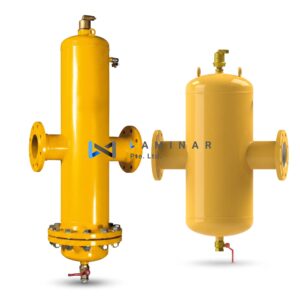
Standard Shell Configuration
- Top Chamber (Micro-bubble Deaeration): When water enters the expanded chamber, fluid velocity drops abruptly. The internal high-performance Stainless Steel 304 (SS304) spiral coalescing mesh causes laminar turbulence, forcing tiny entrained air micro-bubbles to collide, merge into larger bubbles, and continuously rise out of the medium to vent via the integrated automatic air vent.
- Bottom Chamber (Precision Dirt Separation): Concurrently, suspended heavy and fine debris hit the internal spiral structure, completely losing their kinetic energy. Under gravity and cyclonic induction, these particles drop straight down into the dirt collection sump at the base for periodic flushing.
Laminar utilizes a standardized engineering naming nomenclature matrix to customize operational layouts precisely to site design pressures and nominal pipelines:
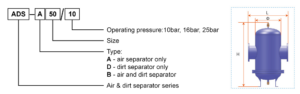
Asset ID: specification-1.png – Model Number Breakdown Code and Dimensional Bounds
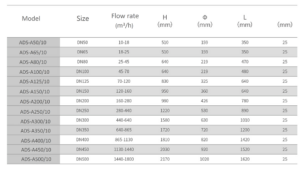
Dynamic Sizing and Flow Capacity Schedule (DN50-DN500)
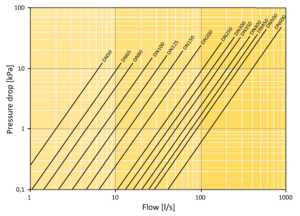
AirDirt-seperator-Pressure-drop-chart – Calibrated Clean State Hydrodynamic Differential Pressure Drop Chart
Critical Installation & Engineering Schematic Guidelines
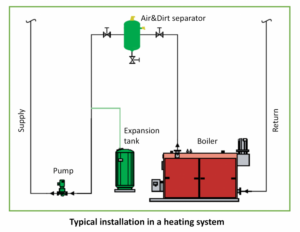
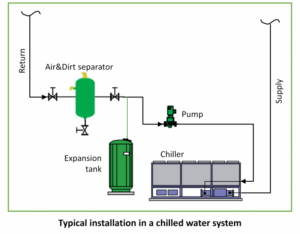
- Upstream Pre-filtration Requirement: Because this is an ultra-high-efficiency clarification device handling micro-particles down to 5 µm, it is highly mandatory to install a standard 20-25 mesh coarse strainer upstream. This traps massive construction debris (e.g., loose slag, heavy welding chunks) during initial commissioning, ensuring the high-precision internal cores do not suffer mechanical damage or premature clogging.
- Laminar Flow Optimization: To guarantee an evenly distributed flow velocity vector entering the separator, please reserve adequate straight pipe lengths before the inlet and immediately after the outlet flanges.
- Glycol Viscosity Correction: When utilizing a maximum 1:1 water-glycol fluid medium at low operational ambient ranges, system pumps should factor in a slight increase in hydraulic resistance due to changes in fluid kinematic viscosity.
- Differential Pressure Monitoring Note: Although data points are theoretical, the differential pressure indicators on site should be monitored closely. When the field gauges reach the calculated upper boundary of 0.10-0.12 bar (10-12 kPa), it indicates a saturated dirt chamber requiring an immediate blowdown flush or an offline core wash via the removable top flange.